
How to Talk to Kids About Death (Ages 2–6): Helping Your Child When a Loved One or Pet Dies
A grandparent has passed away, or the dog or cat who has been part of the family for years is gone. You're still grieving yourself, and now you also have to figure out what to tell your child. Many parents hesitate: they're so young, will they even understand? Will it frighten them?
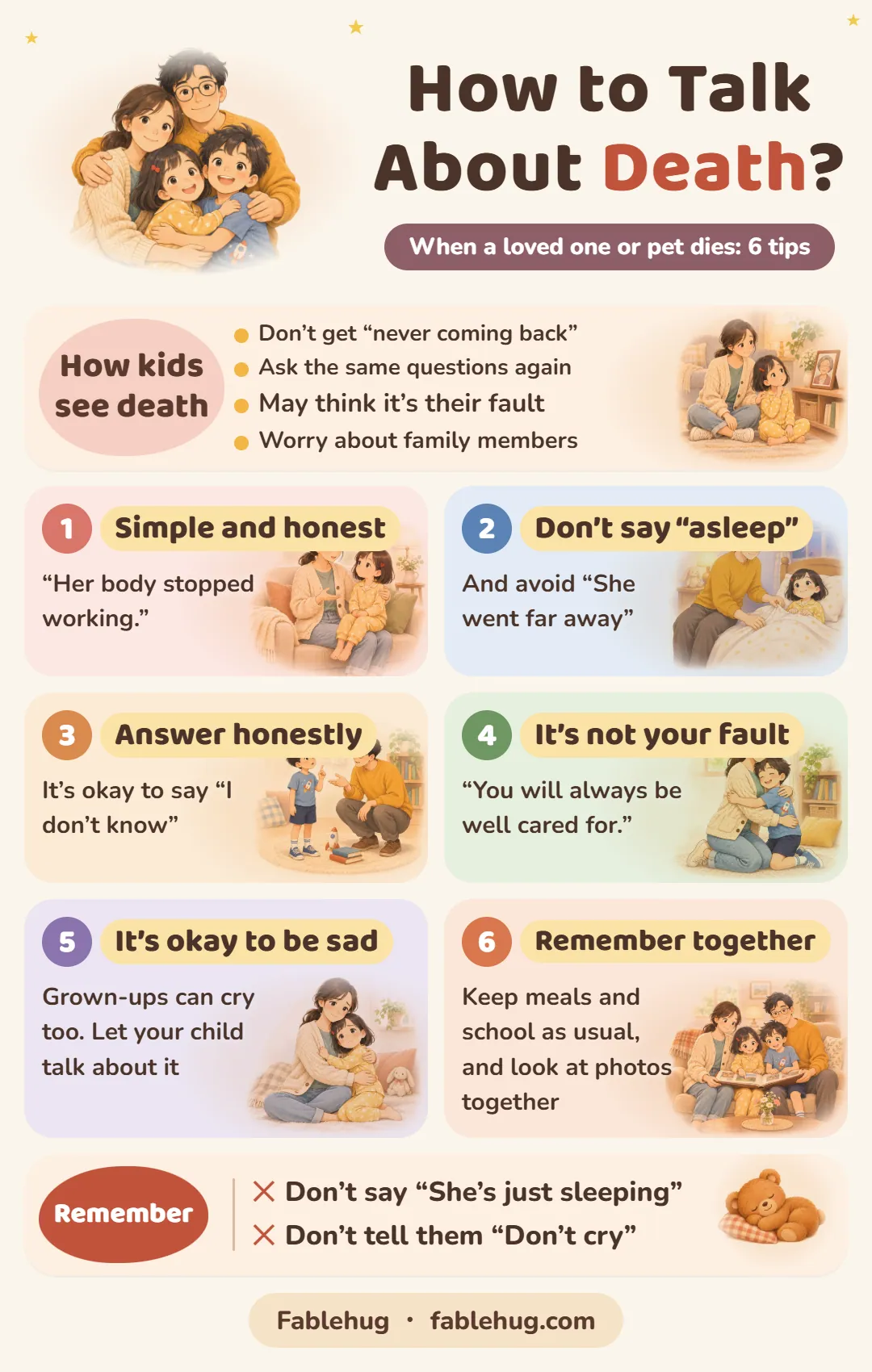
Children aged 2–6 don't fully understand death yet, but they can feel that something at home has changed. Telling them the truth in words they can understand, and then staying close while they slowly take it in, usually reassures them more than keeping it from them. Here are some gentle approaches for families going through this time.
How Do Young Children Understand Death?
- They don't yet understand that it's permanent: Younger children may think dying is like going away on a trip and that the person will come back in a few days, so they keep asking, "When is Grandpa coming back?"
- They ask the same questions over and over: This doesn't mean they didn't understand. Repeating the question is how children slowly make sense of what happened.
- They may think it's their fault: Children sometimes wonder, "Was it because I was naughty?" They need an adult to tell them clearly that it wasn't.
- They grieve differently from adults: A child may be crying one minute and run off to play the next. This is very common and doesn't mean they don't care.
- They may worry about other family members: Some children start asking, "Will Daddy die too?" or "Then who will take care of me?"
How Can Parents Help? 6 Things You Can Do
1. Use simple, honest words
You might say: "Grandma was very, very sick, and her body stopped working. She doesn't breathe anymore, and she doesn't hurt anymore. We won't be able to see her again." Keep your sentences short and clear. Explain the cause in one sentence, such as "She was very, very sick," so your child is less likely to think it was their fault. While you talk, hold your child or have them sit beside you.
2. Avoid phrases like "went to sleep" or "went far away"
These phrases are meant to make things easier, but they can make children afraid to go to sleep, or leave them waiting for the person to come back. If your family has religious or spiritual beliefs about death, you can share them alongside the facts: the body doesn't move anymore, and the person isn't coming back.
3. When your child asks, answer honestly. It's okay to say you don't know
Children may ask very direct questions, like "Is it cold when you're dead?" Answer in a calm voice. If you can't answer a question yourself, it's fine to say, "Mommy doesn't know either. Let's think about it together." However many times your child asks, answer patiently each time.
4. Let your child know: it's not your fault, and you'll be taken care of
Tell your child clearly that the person or pet didn't die because of anything they did. If your child is worried about other family members, you can reassure them: "Mommy and Daddy will take good care of ourselves, and we'll take good care of you."
5. It's okay for adults to be sad, and for children to show their sadness too
It's okay to cry in front of your child. You can say, "Mommy misses Grandma a lot, so I'm feeling a little sad." If you're truly falling apart, ask another adult to stay with your child for a while. Your child will learn that sadness is normal and that it's okay to talk about it. When your child doesn't want to talk, they can also express their feelings through drawing or pretend play with stuffed animals and dolls.
6. Keep daily routines, and find a way to remember together
Meals, preschool, a bedtime story: keep to your usual rhythm as much as you can. Familiar routines help your child feel the world is still safe. You can also do small things together to remember: look at photos, share old memories, draw a card, or plant a little tree.
Picture Books to Help Talk About Saying Goodbye
With stories like these, we suggest parents read them on your own first, then decide when to read them, and whether to read them at all, depending on how your child is doing. If your child is younger, you can explain in even simpler words as you read:
- Pipi Became a Star (Ages 4–5): Puppy Pipi has died. There is sadness, there are memories, and a tree is planted to remember Pipi.
- Goodbye, Old Buddy (Ages 5–6): Buddy is older than Emma, and he is walking slower and slower. Emma takes him on one last walk, and after Buddy is gone, she keeps her memories of him, one by one, under the apple tree in the yard.
- Grandma’s Knitted Hat (Ages 5–6): Grandma has passed away and left a knitted hat she made for her grandchild; wearing it brings Grandma to mind.
- Grandma’s Song Is Still Here (Ages 5–6): Every night, Grandma sings the same song to lull Thando to sleep. Then Grandma gets sick and passes away, the house is strangely quiet, and Thando never wants to hear that song again. Only when his little sister cries and fusses every night does he softly sing the first line in Grandma’s tune.
- Iron Grandpa Says Goodbye (Ages 5–6): The old mech that grew up with Yuyu is retiring, and Yuyu learns to say goodbye properly. (This book isn't about death. It's a good fit for children who haven't experienced a loss yet, as a first conversation about what "saying goodbye" means.)
For more books, see the "Loss & goodbyes" topic.
Frequently Asked Questions
Should I bring my child to the funeral?
There's no right answer. It depends on your child's age, personality and whether they want to go. If you bring them, explain beforehand what they'll see and that people may cry. Arrange for a familiar, calm adult to stay focused on your child, so your child can leave whenever they want to. You can also give them a small job, like placing a flower. If your child doesn't want to go, they can say goodbye at home by drawing a card or saying a few words.
After a pet dies, should we get a new one right away?
There's no need to rush. Give your child and your family time to miss the pet you had. If you hurry to "replace" it with a new pet, your child may feel that being sad isn't allowed. Once the whole family is ready, there's plenty of time to talk about it.
How long will my child be sad? When should I get professional help?
Every child is different. Missing someone may come back around holidays, birthdays or in familiar places, and that's normal. If, after some time, your child is still sleeping poorly or not eating for a long stretch, stays very afraid that they or a family member will die, has gone back to younger behaviors for a long time without improvement, or can no longer play or go to preschool as usual during the day, it's a good idea to talk with your pediatrician or a children's mental health professional. If your child says things like wanting to hurt themselves or wanting to go be with the person who died, please see a doctor as soon as possible. If you're struggling too, it's okay to seek help for yourself as well.
References
- American Academy of Pediatrics HealthyChildren.org: How Children Understand Death: What to Say When a Loved One Dies
- American Academy of Pediatrics HealthyChildren.org: When a Pet Dies: How to Help Your Child Cope
- Child Mind Institute: Helping Children Deal With Grief
- Hospice Foundation of Taiwan: What Can You Do for Your Child? (in Chinese)
When you're missing someone, you can read a story together and slowly talk about what's in your hearts. Fablehug has 600+ picture books for ages 2–6, sorted by age. When your child is ready, you can choose one that fits how they're doing and read it together.


