
Toddler Won't Share and Grabs Toys? 6 Ways to Teach Sharing and Taking Turns (Ages 2–6)
"It's mine!" "I had it first!" A friend comes over to play, and your child clings to their toys and won't let go. Or the moment they see something in another child's hands, they grab it. Try not to worry just yet: it's very common for 2- to 3-year-olds not to share, and 4- to 6-year-olds are still practicing too. Sharing is a skill children learn bit by bit.
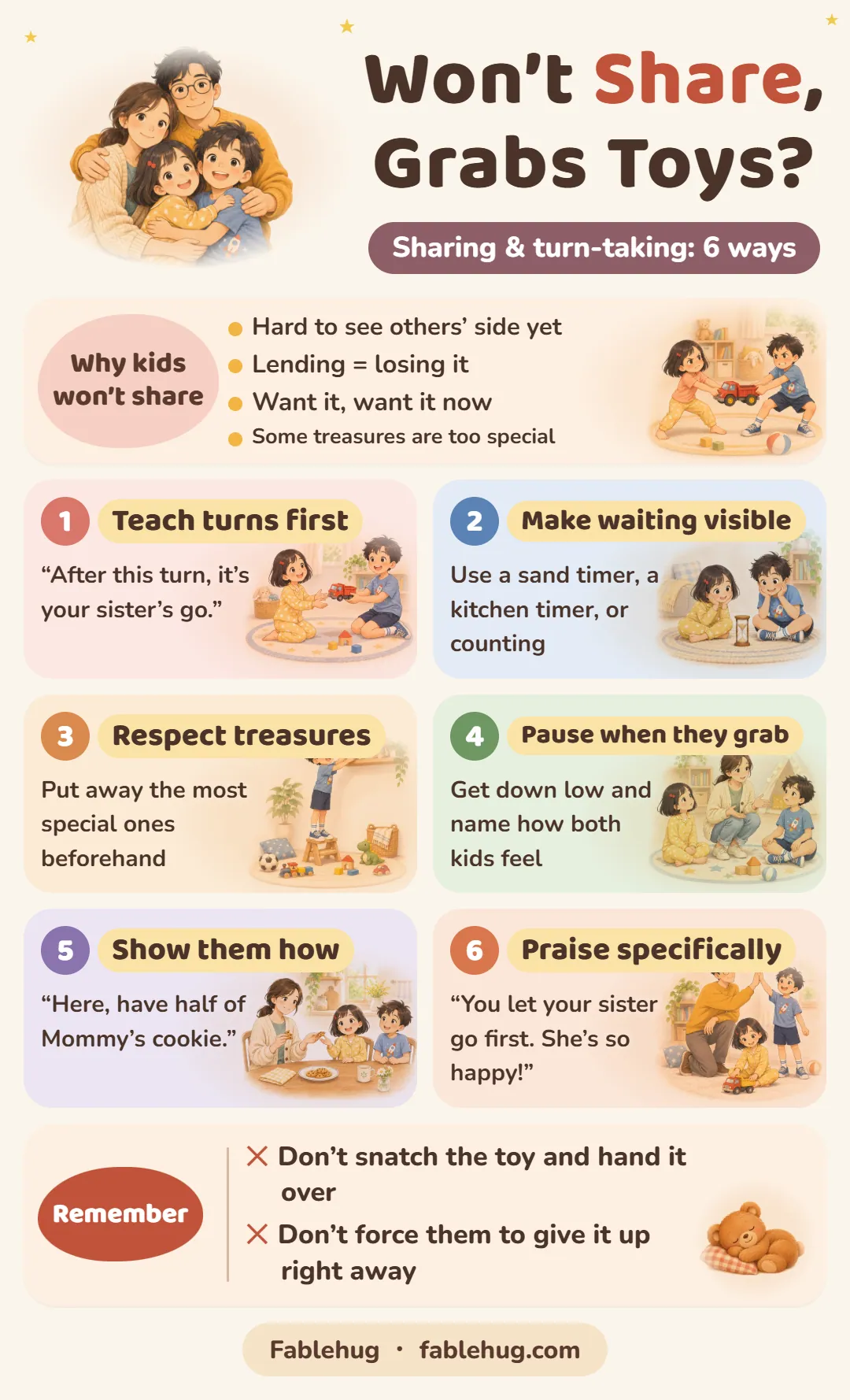
This article covers why kids don't like to share, how you can teach it, and a few picture books about sharing to read together.
Why Won't My Child Share?
- The idea of "mine" is just forming: Around age 2, children start to understand "this is my thing." Holding on to their things is part of discovering who they are.
- It's still hard to see things from someone else's point of view: Children are still learning that "other people have feelings too." The younger they are, the harder it is to think about a friend's feelings when they really want something.
- They don't understand time yet: To a child, "lending it out" can feel like "it's gone." They don't know they'll get it back in a little while.
- When they want something, they want it now: Waiting takes patience, and that's something preschoolers are still practicing.
- Some things are extra special: Every child has treasures they can't bear to part with, just like adults don't always want to lend out their phones.
What Can Parents Do? 6 Ways to Help
1. Teach "taking turns" first, and don't rush them to "give it away"
For little kids, "one turn for you, one turn for me" is easier to understand than "give it to someone else." You might say, "When you finish this turn, it's your brother's turn," so your child knows the toy will come back.
2. Make waiting something they can see
Kids don't have a sense of time, so try counting, a sand timer, a kitchen timer, or "three times down the slide, then switch." When they can see the finish line, waiting isn't so hard.
3. Respect your child's treasures
Before friends come over, let your child put away the one or two things they care about most, then bring out the other toys to play with together. When children feel their feelings are respected, they're more willing to share other things.
4. When someone grabs, the grown-up hits pause first
When your child grabs a toy or has one grabbed from them, get down to their level, stop the situation, and name how both kids feel: "You really want to play with the car, and your brother is still playing with it." Then teach your child to use words: "Can I have a turn?" "I'm still playing. You can have it in a minute."
5. Show them how
Kids are great copycats. In everyday life, you can model it: "Here, have half of my cookie," "Let's take turns pressing the elevator button." Play lots of turn-taking games at home, like tossing a ball or stacking blocks, and your child will practice while they play.
6. Praise specifically when you see it
When your child takes turns or shares on their own, say exactly what you noticed: "You let your sister go first, and she was so happy." Helping your child feel the good feeling that comes from sharing works better than constantly asking them to do it.
Picture Books for Learning to Share
Stories let children see what "taking turns" and "sharing" look like, so the next time it happens, they have a better idea of what to say:
- Little Dinosaur Can Share (Ages 2–3): Little T. rex hugs the ball and won’t let go, and finally learns “one turn for you, one turn for me.”
- Your Turn! (Ages 2–3): Swing until we count to ten, then switch.
- Octopus’s Eight Arms Want to Play (Ages 3–4): Eight arms hugging a pile of toys end up unable to play with any of them.
- My Little Brother Grabs My Toys (Ages 3–4): Little Brother keeps grabbing the blocks, and big sister is so mad, until she learns to say “I’m still playing. You can have it in a minute.”
- You Can Borrow It, but Give It Back! (Ages 4–5): Agree on a time before borrowing a toy, and say thank you when you give it back.
- The Shape-Shifting Robots’ Sharing Lesson (Ages 5–6): Every robot wants the newest wheels, and they learn to take turns and fix things together.
For more books, see the "Sharing & taking turns" topic.
Frequently Asked Questions
If my child won't share, should I make them hand the toy over?
It's best not to take the toy straight out of your child's hands and give it to someone else. That makes it harder for them to learn how to take turns. A better approach is to teach turn-taking and agree on a time, so your child hands the toy over themselves.
My child keeps grabbing other kids' toys. What should I do?
First, give the toy back to the child who had it. Then help the child who grabbed it put their feelings into words, and teach them to ask: "Can I borrow it?" If the other child is still playing, wait together, or find something else to play with in the meantime.
When should I talk to a professional?
Sharing and taking turns improve gradually with age, and most children take turns when playing games by around age 5. If your child is past 3 and still rarely plays with other children, or often hurts others, and their teacher has noticed the same thing, don't wait. Talk to your pediatrician or a child development professional.
References
After the story, play a turn-taking game together. Fablehug has 600+ picture books for ages 2–6, sorted by age, so you can pick stories that fit what your child is going through right now.


