
Why Is My Child Lying? Reasons Kids Ages 2–6 Lie and 6 Ways to Respond
There's milk all over the floor, and your child is standing right next to it saying, "It wasn't me." There's chocolate all over their hands, but they insist, "I didn't eat any." The first time you catch your child in a lie, it can be a shock, and many parents worry their child is "going down the wrong path." Take a deep breath: lying is very common in the preschool years and usually starts around age 3. It also shows that your child is beginning to understand that "other people don't always know what I'm thinking."
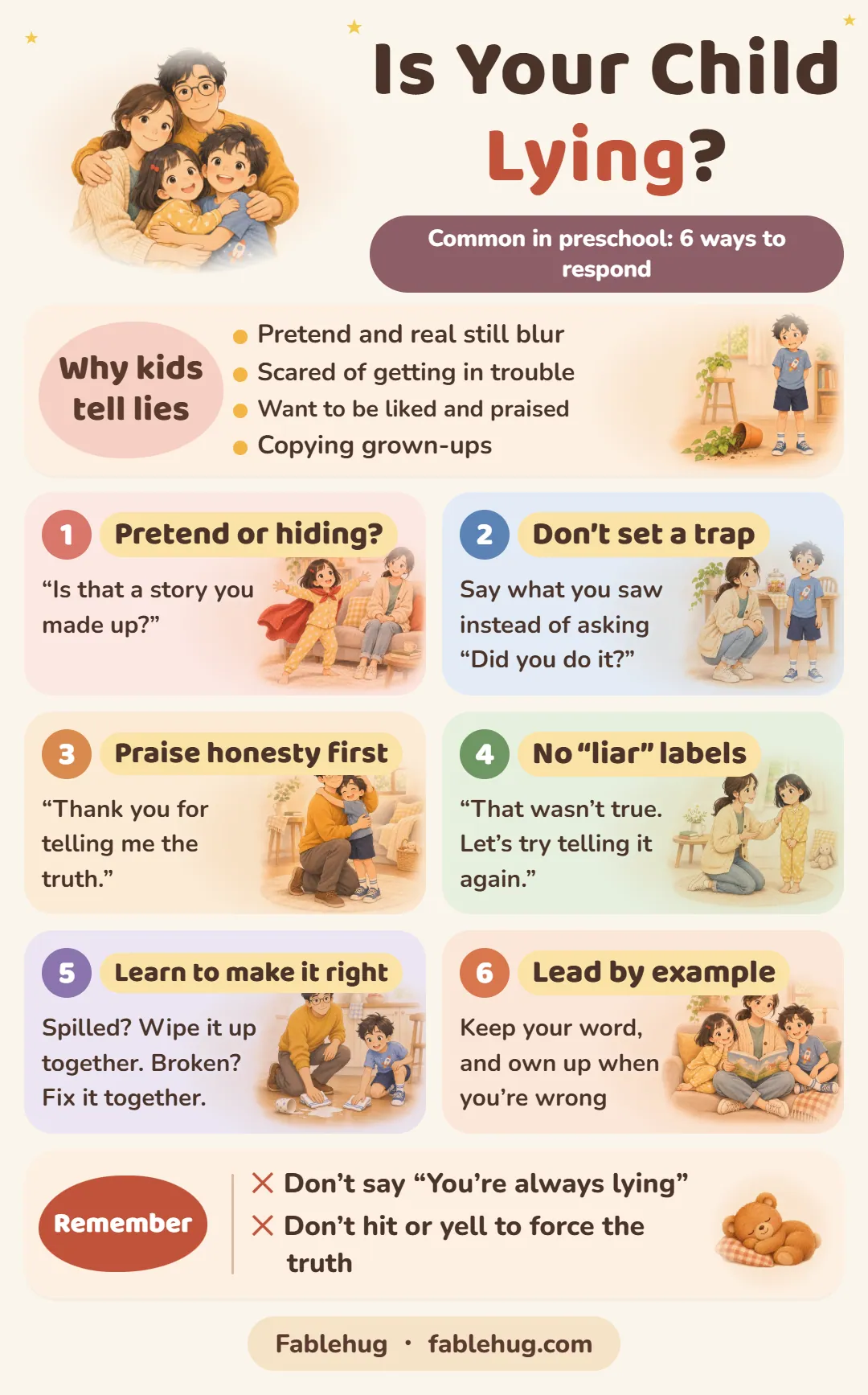
This article covers why children lie, how parents can respond, and a few picture books you can read together to start a conversation about honesty.
Why Do Children Lie?
- They can't always tell imagination from reality yet: Young children often describe what they *wish* had happened as if it really did, like "There's a dinosaur at my house." This is more like imagination and isn't necessarily an attempt to deceive.
- They're afraid of getting in trouble: When they've done something wrong, "It wasn't me" is the quickest way to protect themselves. Harsh punishment can actually make children want to hide things even more.
- They want to be liked or praised: To make friends or make grown-ups happy, children may make a story sound a little more impressive.
- They want something: "Mom said I could have candy" is a way to get something they want.
- They're copying adults: Children notice how grown-ups talk, including the little white lies adults tell without thinking.
What Can Parents Do? 6 Ways to Respond
1. Figure out whether it's "imagination" or "covering up"
If your child says, "I flew to the moon yesterday," you can smile and play along: "Wow, is that a story you made up?" This also helps them learn the difference between pretend and real. The lies that really need your attention are the ones told to avoid responsibility.
2. If you already know the answer, don't ask
If you can see chocolate around your child's mouth, asking "Did you sneak some chocolate?" just gives them a chance to lie. Instead, say it directly: "I can see you had some chocolate. We agreed no chocolate before dinner." Then focus on what happens next.
3. When your child tells the truth, praise the honesty first
"Thank you for telling me the truth. I know that wasn't easy." Acknowledge the truth-telling first, then deal with what went wrong. When children see that telling the truth doesn't make things worse, they'll be brave enough to do it next time.
4. Focus on the behavior, not the child; don't label them a "liar"
Saying things like "You're always lying" can make children believe that's just who they are. Try "What you just said wasn't true. Let's try saying it again," and stick to what actually happened.
5. Help your child learn to make things right
Rather than scolding or punishing, it's more helpful to fix things together: if something spilled, clean it up together; if something broke, figure out what to do together; if they took something that belongs to someone else, give it back together. Your child will learn that mistakes can be fixed.
6. Set an example, and use stories to talk about honesty
Children watch what adults do. Try to keep your promises, and when you get something wrong, own up to it openly. You can also read stories about honesty together and ask your child, "If you were them, what would you do?" Children are more likely to share how they really feel when you talk at a calm, relaxed time.
Picture Books for Talking About Honesty
When a character in a story tells a lie, feels bad inside, and finally finds the courage to tell the truth, children can easily put themselves in that character's shoes:
- It Wasn’t Me! (Ages 3–4): Little Fox breaks a vase and tells a lie. His heart feels so heavy that in the end he tells the truth.
- The Magic Mirror Tells the Truth (Ages 4–5): The little princess breaks a vase, and the magic mirror asks her, “Will you tell the truth?”
- The Magic Gadget Rental Shop (Ages 4–5): Yuyu borrows an “auto-draw pen” but pretends the picture is his own, and it makes his heart feel awful.
- The Little Detective’s Honesty Test (Ages 5–6): Finding a classmate’s sticker, the little detective really wants to keep it, but finally returns it to its owner.
- We Have a Horse at Home (Ages 5–6): To make friends, Owen, who has just transferred to a new school, says, “We have a horse at home.” His classmates crowd around, so he has to keep making it bigger: it can run, it can jump, it’s golden. This weekend the classmates are coming to see the horse, and Owen has only one way out: telling the truth.
For more books, see the "Honesty & giving back" topic.
Frequently Asked Questions
My 3-year-old makes things up all the time. Is that lying?
Not necessarily. Children this age often mix imagination, wishes and reality when they talk, but they're also starting to say "It wasn't me" to avoid getting in trouble. There's no need to punish the pretend stuff. Just help them sort it out: "Is that something you imagined, or did it really happen?"
Should I punish my child for lying?
Focus on "telling the truth" and "making things right" rather than punishment. If your child needs to face a consequence for something they did, make it connected to what happened, like cleaning up together or saying sorry. Avoid hitting, yelling or very harsh punishments, so your child doesn't get even better at hiding things to avoid being punished.
When should I talk to a professional?
For most children, lying gradually decreases as they get older and with gentle guidance. If the lying is very frequent or getting worse, often comes with other ongoing behavior problems, or is clearly affecting your child's life at home or school and their relationships, consider talking to your pediatrician or a child psychology professional.
References
Read a story about telling the truth, then talk about it together. Fablehug has 600+ picture books for ages 2–6, sorted by age, so you can choose stories that fit what your child is going through right now.


